How to Schedule the First Comment on Your LinkedIn Posts from Notion
The first comment is one of the most effective LinkedIn growth strategies. Here's why it works, how to use it, and how to automate it directly from your Notion workspace with Scheduled.
Why the First Comment Matters on LinkedIn
LinkedIn's algorithm penalizes posts that contain external links. When you add a URL directly in your post body, LinkedIn reduces its reach - sometimes by 40-50% compared to a text-only post. The platform wants to keep users scrolling, not clicking away.
This creates a problem for anyone who wants to share a link to their website, newsletter, product, or article. You either sacrifice reach by putting the link in the post, or you sacrifice the link entirely.
The solution that top LinkedIn creators use: publish a clean, link-free post, then immediately add the link as a first comment. The algorithm doesn't penalize links in comments the same way it penalizes links in the post body. Your post gets full reach, and your link is still accessible.
But the first comment isn't just about links. Smart creators use it to:
Add context without cluttering the post. Your main post stays clean and focused on the hook and story. The first comment adds supplementary information, resources, or background.
Include a call to action. "Want the full template? Link in the first comment" is a proven engagement driver. People scroll down to the comments, which signals engagement to the algorithm.
Tag people or companies. If your post mentions several people, tagging them all in the post body looks spammy. Moving some mentions to the first comment keeps the post readable.
Share multiple links. Sometimes you want to reference an article, a tool, and a signup page. Stacking links in the post body kills reach. The first comment is the right place for them.
The Problem: Timing the First Comment
The strategy only works if the first comment appears immediately after the post is published. If you publish your post and then manually add the comment 5 minutes later, someone else's comment might appear first - pushing your link down. Or worse, you forget entirely.
This is especially painful if you schedule posts in advance. You set a post to publish at 8:30 AM, but you're in a meeting at 8:30 AM. By the time you remember to add the first comment, it's 10 AM and the post already has other comments above yours.
For ghostwriters managing multiple client profiles, the problem multiplies. You're scheduling posts for 5 clients across different time zones. Manually adding first comments to each post at the exact right moment is not sustainable.
How to Automate the First Comment from Notion with Scheduled
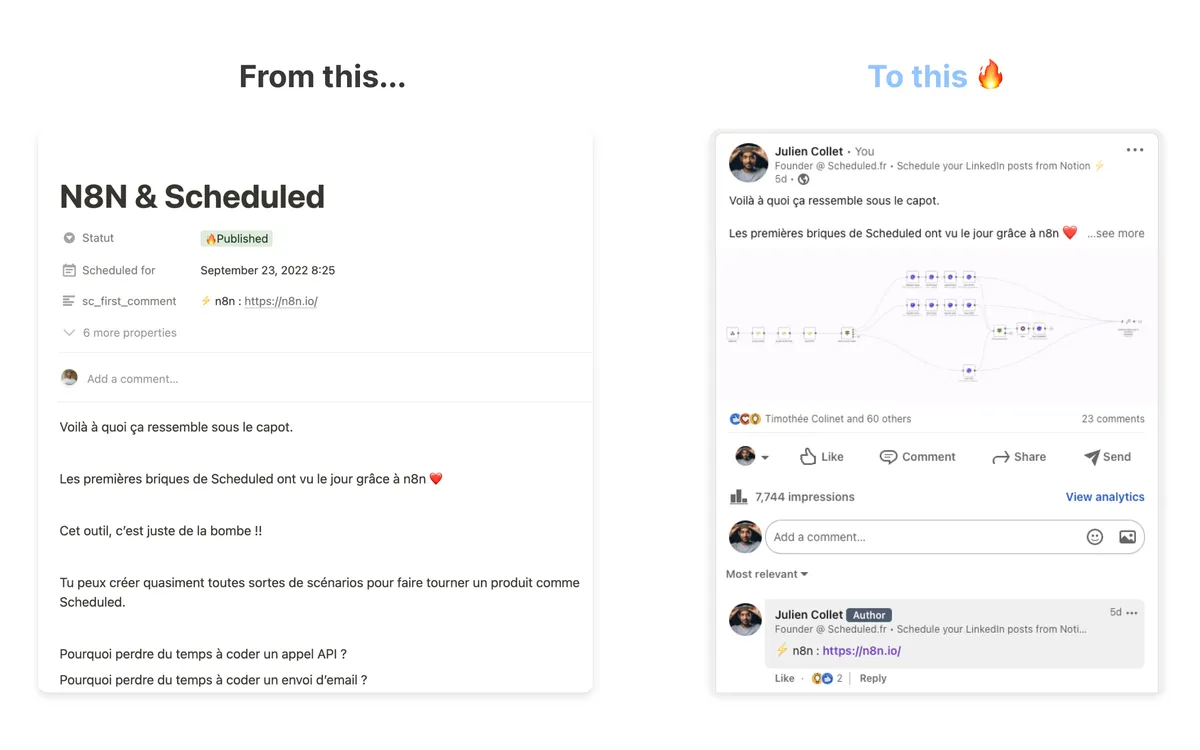
Scheduled is the only Notion-to-LinkedIn tool that supports automatic first comment scheduling. Here's how to set it up:
Step 1 - Add the first comment property to your Notion database
In your Notion database, create a new property:
- Property name:
sc_first_comment - Property type: Text
That's it. No complex configuration, no separate interface to learn.
Step 2 - Write your first comment in Notion
For any post where you want a first comment, fill in the sc_first_comment property with the text you want to appear as the comment. You can include:
- External links (URLs will be clickable on LinkedIn)
- Hashtags
- Text formatting
- Mentions (using the same hyperlink method as in your posts)
Step 3 - Schedule your post as usual
Set the publication date, change the status to "Ready to be scheduled," and Scheduled handles the rest. When your post goes live on LinkedIn, the first comment is published automatically - within seconds of the post, before anyone else can comment.
Step 4 - Verify in Notion
After publication, your Notion status updates to "Published." The first comment is live on LinkedIn and visible to your audience immediately.
Best Practices for LinkedIn First Comments
Keep the post body clean
The whole point of the first comment strategy is to separate your content from your links. Don't put half a link in the post and the other half in the comment. Make your post self-contained and valuable on its own. Then use the first comment to add the link or CTA.
Tell people to check the comment
Adding a line like "Link in the first comment" or "Resources in the comments" at the end of your post works extremely well. It drives people to your comment (boosting engagement signals) and ensures they find your link.
Don't overload the first comment
One or two links maximum. A brief sentence of context. That's it. If your first comment is a wall of text with 5 links, it defeats the purpose. Keep it concise and focused.
Use it for every post with a link
Make it a habit. If your post references an external resource, the link goes in the first comment. No exceptions. This consistency trains your audience to look for your comment, and it protects your reach on every post.
Ghostwriters: use it for client CTAs
If you manage LinkedIn content for clients, the first comment is perfect for their call to action. The post builds authority and trust. The first comment drives the business action. This separation makes the content feel less promotional while still delivering results.
Examples of Effective First Comments
For a thought leadership post:
"Full article with the 7-step framework: [link]. If you found this useful, share it with your team."
For a product launch:
"Try it free for 14 days - no credit card required: [link]"
For a newsletter promotion:
"This is from my weekly newsletter on LinkedIn strategy. Subscribe here: [link]"
For a carousel post:
"Download the PDF version of this carousel: [link]. And follow me for more frameworks like this."
For a case study:
"Read the full case study with all the numbers: [link]. Happy to answer questions in the comments."
First Comment vs. Link in Post: The Data
Multiple studies and LinkedIn creator experiments have shown consistent results:
Posts with links in the body typically see 30-50% lower impressions compared to text-only posts. Posts using the first comment strategy maintain their full organic reach while still delivering the link to their audience.
The engagement pattern is also different. When the link is in the post body, people click it and leave LinkedIn - the platform registers this as a negative signal. When the link is in the first comment, people engage with the post first (read, react, comment), then find the link. This generates more engagement signals before the click-away.
FAQ
Does the first comment really affect reach?
Yes. LinkedIn's algorithm reduces the visibility of posts containing external links in the body. Moving links to the first comment avoids this penalty while still making your link accessible.
How fast does Scheduled publish the first comment?
The first comment is published within seconds of the post going live - fast enough that it always appears as the first comment, before any audience engagement.
Can I schedule a first comment on Instagram or other platforms?
The first comment scheduling feature is currently available for LinkedIn. For other platforms, the comment must be added manually after publication.
Does the first comment work on LinkedIn company pages?
Yes. Scheduled supports first comment scheduling for both personal LinkedIn profiles and LinkedIn company pages.
What if I don't fill in the sc_first_comment property?
If the property is empty, Scheduled simply publishes the post without a first comment. No error, no issue - it's completely optional per post.
Can my first comment include formatting?
Yes. You can include line breaks, emojis, and links. Bold formatting in the first comment follows the same rules as in your post body.
Scheduled is the only Notion-to-LinkedIn tool that supports automatic first comment scheduling. Start your free trial →